Manual.ly Logo

JBL Aquaristic ProAquaTest Lab Manual

0,0 · 0 Valoraciones

Manual en PDF · 65 Páginas

Español

M: QW-35-FL
página

/ 65

Loading...
20bbaef5bdec311f8d8e156c4e1fe9d6e449 page 9
16 17
deciency. Iron and some other trace elements are only sta-
ble in water for a limited time, even if they are bound to so-
called chelators, as is usual in modern fertilisers. In addition
any tap water added is usually iron-free. Therefore, the iron
content needs to be monitored regularly with this test and re-
plenished if necessary. Cncentrations as low as 0.1–0.2 mg/l
are sufcient for good plant growth. In very densely planted
aquariums, values of up to 0.6 mg/l can also be useful. In
marine water, values of up to 0.05 mg/l are recommended.
Procedure:
1. Rinse both test vials several times with the water to be
tested.
2. Use the enclosed syringe to ll each of the test vials with
5 ml of sample water.
3. Add 5 drops of Fe reagent to one of the two test vials and
mix by swirling. Allow to stand for 10 minutes until the
colour has developed completely.
4. Place both test vials in the grey comparator block: Place
the vial with added reagent at the smooth end and the
vial with untreated sample water (blank sample) at the
notched end of the comparator block.
5. Place the comparator block with the two test vials on the
colour chart in such a way that the notch points to the
values and move it on the colour chart until the colour of
the sample mixed with reagents corresponds as closely
as possible to the colour under the blank sample.
6. Read the iron content in the notch of the comparator.
Note:If you decide to use the JBL PRO AQUATEST NH
4
at
the same time, make sure you don’t mix up the measuring
vessels of either set. Traces of the JBL PRO AQUATEST
NH
4
left inside the measuring vessel may result in too high
readings in the iron test.
Correcting deviating values:
Too low: Fertilise with ferrous fertilisers from the JBL ferti-
liser range (e.g. JBL Ferropol).
Too high: Carry out the corresponding partial water change.
JBL PRO AQUATEST K
Features: JBL PRO AQUATEST K is an easy-to-use turbid-
ity test for the routine monitoring of the potassium content in
fresh and marine water.
Why test? Potassium is one of the macroelements which is
very effectively absorbed within a few hours and temporarily
stored by plants in fresh water. Growing plants require more
potassium compared to other elements. As a result, potas-
sium concentrations can drop to a minimum range, causing
plant growth to stagnate, even if the aquarium water is ferti-
lised regularly. Potassium deciency initially leads to chloro-
tic spots on the edges of the leaf, which gradually increase
and then turn into grey-brown necroses. The leaves may
crinkle or curl. In Central European tap water, potassium is
usually a decient element compared to in natural biotopes
and this especially applies to calcium and magnesium con-
centrations. For good plant growth, the potassium content
needs to be at around 10 mg/l, in aquariums with high il-
lumination (e.g. in so-called scapes) up to 30 mg/l can be
useful. Higher potassium values in aquarium water encour-
age the growth of green thread algae. Potassium is present
in seawater in concentrations of about 380–400 mg/l, but is
only consumed in small quantities. Excessively high potas-
sium contents can be dangerous for sensitive animals such
as shrimps. The potassium content of the aquarium water
needs to be measured on a daily basis initially. This enables
the needs of the plants to be determined and the dosage of
the fertiliser can be carried out accordingly. Afterwards, rou-
tine measurements can be carried out after longer intervals.
Procedure:
Freshwater:
1. Rinse the measuring tube (plastic) and the tube (glass)
for the potassium content reading several times with the
water to be tested.
2. Using the syringe supplied, ll 15 ml of sample water into
the measuring tube.
3. Add 10 drops of reagent 1 and mix by swirling.
4. Add 1 large level measuring spoon (broad end of the
enclosed double-ended spoon) of reagent 2 and swivel
slightly for about 30 seconds until the powder has dis-
solved. The water becomes whitish and cloudy. Leave to
stand for 1 minute and then swirl slightly again.
5. Place the glass tube for reading the potassium content
reading on the cross of the colour card.
6. The following procedure should be carried out in bright,
diffuse light. Pour the´ turbid water from the measuring
tube into the reading tube until the turbidity means the
cross on the colour card is no longer visible from above.
7. The potassium content can now be read on the scale of
the tube (bottom of the meniscus).
Marine water:
1. Fill 10 ml sample water with distilled water to 300 ml.
2. Follow the same steps as for fresh water.
3. Multiply the test result by a factor of 30.
Correcting deviating values:
Too low: In freshwater aquariums fertilise with potassium-
containing fertilisers from the JBL ProScape range. We do
not recommend an additional dosage in marine water be-
cause potassium is toxic for various organisms.
Too high: Repeat the measurement after 24 hours. If the
value is still too high, carry out the corresponding partial
water change.
JBL PRO AQUATEST Cu
Features: JBL PRO AQUATEST Cu is an easy-to-use color-
imetric test to routinely determine the copper content in fresh
and marine water aquariums, and in garden ponds. A com-
pensation method developed by JBL allows reliable results
to be obtained even in slightly discoloured water (caused by
peat ltering or disease treatment etc.).
Why test? Copper is a heavy metal which is on the one
hand indispensable as a trace element for plant and animal
organisms. On the other hand it has a devastating effect
as a cell poison (cytotoxin) above a certain concentration.
Copper mainly reaches the aquarium in tap water, as cop-
per pipes were often used for water installation. If the water
remains in such pipes for a longer period of time, consid-
erable amounts of copper can dissolve. The water in the
pipe should therefore be drained before use. For the same
reason, do not use rainwater that has owed over copper
gutters. And make sure the tools you use when setting up
your aquarium or pond are copper-free. A controlled entry
of copper takes place through the application of medications
against parasitic sh diseases, as well as with some algae-
killing agents. The copper concentrations prescribed for this
can be tolerated by sh for a certain time while parasites,
etc., start dying off immediately.
Please note: Copper quickly forms water-insoluble com-
pounds which form deposits on the ground. The JBL PRO
AQUATEST Cu only detects copper dissolved in water.
Procedure:
1. Rinse both test vials several times with the water to be
tested.
2. Use the enclosed syringe to ll each of the test vials with
5 ml of sample water.
3. Add 5 drops of reagent 1 to one of the two test vials and
mix by swirling. Then add 5 drops of reagent 2 and mix
again. Allow to stand for 15 minutes until the full colouring
develops.
4. Place both test vials in the grey comparator block: Place
the vial with added reagent at the smooth end and the
vial with untreated sample water (blank sample) at the
notched end of the comparator block.
5. Place the comparator block with the two test vials on the
colour chart in such a way that the notch points to the
values and move it on the colour chart until the colour of
the sample mixed with reagents corresponds as closely
as possible to the colour under the blank sample.
6. Read the copper content in the notch of the comparator.
Correcting deviating values:
Too low: The value should always remain below the detec-
tion limit (except for some special treatments).
Too high: Regular use of JBL water conditioners, such as
JBL Biotopol or ltering with JBL’s high performance acti-
vated carbon. Water-insoluble copper compounds can only
be eliminated by removing the complete substrate.
JBL PRO AQUATEST O
2
Features: JBL PRO AQUATEST O
2
is an easy-to-use colori-
metric test for the routine monitoring of the oxygen content
in fresh and marine water aquariums, and in tap and garden
pond water, within a range of 1–10 mg/l (ppm).
Why test? All animals living in water need oxygen to
breathe. Even the „invisible helpers“ in aquariums and
ponds, the cleansing bacteria, are dependent on a suf-
cient oxygen content for the conversion of ammonium to
nitrate. The oxygen supply they need can be safeguarded
by adequate planting. In aquariums and ponds with little or
no planting and in marine aquariums, the oxygen content
always needs to be kept at the appropriate saturation value
with the help of technical equipment. The saturation value
depends on the water temperature (see table on last page).
Plants are able to exceed this saturation value through their
assimilation activity. In well planted aquariums and ponds,
for example, values can be found towards the end of the
lighting period, which are 1 to 2 mg/l higher than the satura-
tion value.
Procedure:
1. Rinse the measuring vessel several times with the water
to be tested.
2. Fill the measuring vessel to the brim with the water to be
tested by immersing it in water and place it on a water-
proof surface.
3. Add 6 drops of O
2
reagent 1 and 6 drops of O
2
reagent
2 slowly one after the other, until the measuring vessel
overows.
4. Avoiding bubble formation, close the measuring vessel
bubble-free with the enclosed cap and shake vigorously
for approx. 30 seconds.
5. Remove the cap from the measuring vessel and add 6
drops of O
2
Reagent 3.
6. Close the measuring vessel again (bubbles no longer
matter) and shake vigorously for approx. 30 seconds. Al-
low to stand for 10 minutes until the full colouring devel-
ops.
7. Move the measuring vessel back and forth approx. 3–5
cm above the white part of the colour chart and select the
colour with the best possible match.
8. Read the oxygen content off the relevant colour eld.
Correcting deviating values:
Too low: Put in more plants and/or improve care of exist-
ing plants, e.g. by installing a CO
2
supply unit (JBL ProFlora
CO
2
kit). Improve ventilation, e.g. with a JBL ProSilent air
pump and/or improve water movement on the surface with
ow pumps, protein skimmers (marine water) or in garden
ponds with stronger pumps (pond lters) in conjunction with
a waterfall or watercourse.
Too high: Not applicable.
JBL PRO AQUATEST CO
2
Direct
Features: JBL PRO AQUATEST Ca is an easy-to-use titra-
tion test to determine the carbon dioxide content of fresh-
water.
Why test? Carbon dioxide (CO
2
) is the most important plant
nutrient. The consumption of CO
2
differs from aquarium to
aquarium and depends, amongst other things, on the fol-
lowing factors: number and demands of plants, carbonate
hardness, water movement and light. Fertilisation with CO
2
is usually done with a CO
2
fertiliser system. In the aquarium
water, a CO
2
content between 15 and 30 mg / l is recom-
mended. This range is safe for sh and at the same time en-
sures luxuriant plant growth. 20–25 mg/l CO
2
has proven to
be ideal. In special aquariums with a large number of plants,
so-called scapes, higher values of up to 35 mg/l may be re-
quired. With this test you can determine the CO
2
content of
your aquarium water in mg/l and thus monitor the setting of
your CO
2
fertiliser system.
Please note: When fertilising with so-called liquid carbon,
fertiliser monitoring with JBL PRO AQUATEST CO
2
Direct is
not possible because these fertilisers do not contain CO
2
but
other carbon compounds.
Procedure:
1. Rinse the measuring vessel and syringe several times
with the water to be tested.
2. Using the syringe, insert 20 ml of bubble-free sample
water into the measuring tubes.
3. Place the measuring tube on both elds of the enclosed
colour chart.
4. Pour 5 drops of reagent 1 into the measuring tube on the
white eld and swirl it until it is mixed.
5. Add reagent 2 drop by drop. After each drop, swirl and
count the drops until a pink colour is obtained which re-
mains stable for 60 seconds and corresponds to the col-
our in the second measuring tube on the pink colour eld.
To compare the colours, look into the tubes from above.
6. The number of drops multiplied by 2 gives the carbon di-
oxide content in mg/l. Example: 10 drops of reagent 2 =
20 mg/l CO
2
.
Since other acids in the water impair the measurement, a
blank value must also be determined. To do this, take a wa-
ter sample of 100 ml and aerate it for 15 min using a JBL
ProSilent air pump with an air stone. Then determine the
blank value according to the instructions given above.
Result–blank value = actual carbon dioxide concentration
in mg/l.
Correcting deviating CO
2
values:
Too low: Add carbon dioxide to the aquarium using a JBL
ProFlora CO
2
fertiliser system.
Too high: Aerate the aquarium using a JBL ProSilent air
pump.
CO
2
table
Special feature: The CO
2
table enables you to determine
the carbon dioxide content through the carbonate hardness
(KH) and the pH value of the water. This method should only
be used if no pH-lowering substances, such as nitrate or
peat, are in the water.
Why test?
Carbon dioxide (CO
2
) is the most important plant nutrient.
The consumption of CO
2
differs from aquarium to aquarium
and depends, amongst other things, on the following factors:
number and demands of plants, carbonate hardness, water
movement and light. Fertilisation with CO
2
is usually done
en
en
en
en
en

Chatee con su manual de JBL Aquaristic ProAquaTest Lab usando IA

Obtenga respuestas instantáneas de IA de su manual de JBL Aquaristic ProAquaTest Lab

Pregunte lo que quiera sobre JBL Aquaristic ProAquaTest Lab. Las respuestas provienen de este manual, con las páginas en las que se basan.

ProAquaTest Lab Programa de mantenimiento

Diario
Medir el contenido de magnesio en acuarios de agua dulce

Mida inicialmente a diario para determinar las necesidades de las plantas y la dosis de fertilizante. Luego, cambie a intervalos más largos.

Mostrar en el manual (página 3)
Diario
Medir el contenido de potasio en acuarios de agua dulce

Mida inicialmente a diario para determinar las necesidades de las plantas y la dosis de fertilizante. Luego, cambie a intervalos más largos.

Mostrar en el manual (página 9)
M: qwen/qwen3.8-flash

Haz una Pregunta

0/1000

¿Recomiendas ProAquaTest Lab?

Sí No

Preguntas frecuentes

A

Asegure resultados precisos enjuagando todos los recipientes varias veces con agua de muestra antes de la prueba. Sostenga los cuentagotas verticalmente para evitar burbujas de aire. Siga los tiempos de espera específicos para el desarrollo del color. Compare los colores contra la tabla en un fondo blanco. Use las jeringas y bloques comparadores proporcionados para volúmenes consistentes.

¿Esta respuesta fue útil?

A

Las fluctuaciones en el pH pueden dañar los organismos acuáticos. Los cambios repentinos son particularmente estresantes. El agua descolorida puede interferir con las lecturas, pero los métodos de compensación ayudan. Mida siempre a la misma hora del día ya que la luz afecta los niveles de CO2 y el pH. Evite probar inmediatamente después de agregar químicos o comida.

¿Esta respuesta fue útil?

A

Verifique parámetros críticos como el pH y el amoniaco regularmente, especialmente en nuevos montajes. Pruebe nutrientes como nitrato y fosfato mensualmente una vez que el sistema sea estable. Verifique el GH y el KH semanalmente para controlar las tendencias de dureza. Pruebe los niveles de oxígeno si los peces muestran signos de estrés o en tanques muy poblados. La frecuencia depende de la densidad de siembra y del tamaño del tanque.

¿Esta respuesta fue útil?

A

Sí, el manual cubre acuarios de agua dulce, acuarios marinos y estanques de jardín. Existen pruebas específicas para estanques de Koi con alta densidad de stock. Las pruebas de dureza general y pH se aplican a la mayoría de los entornos de agua dulce. Las pruebas de CO2 son específicas para acuarios plantados con ciclos activos de crecimiento de plantas.

¿Esta respuesta fue útil?

A

El amoniaco alto indica un problema con el filtro biológico. Realice un cambio de agua parcial grande inmediatamente. Agregue bacterias beneficiosas para restaurar el ciclo del nitrógeno. Verifique si los medicamentos usados recientemente dañaron las bacterias beneficiosas. Asegúrese de que la alimentación se reduzca hasta que los niveles vuelvan a los límites seguros. Monitoree el pH ya que afecta los niveles de toxicidad del amoniaco.

¿Esta respuesta fue útil?

A

Corrija la baja dureza carbonatada agregando acondicionadores de agua JBL que contienen bicarbonatos. También puede usar mezclas de sales minerales diseñadas para acuarios. Evite suavizar el agua si ya es demasiado baja. Monitoree de cerca después del ajuste para evitar cambios de pH. Pruebe nuevamente después de 24 horas para confirmar la estabilidad.

¿Esta respuesta fue útil?

A

Almacene los reactivos secos a temperatura ambiente en su embalaje original. Manténgalos lejos de la luz solar directa y fuentes de calor. Asegúrese de que los cuentagotas estén secos por fuera antes de devolverlos a las botellas. No mezcle las tapas entre diferentes kits de prueba. Verifique las fechas de caducidad regularmente, ya que los reactivos viejos pueden dar resultados inexactos.

¿Esta respuesta fue útil?

M: QW-35-FL

Ventajas y Desventajas

Ventajas

  • Amplia gama de pruebas que cubre todos los parámetros clave para diversos montajes acuáticos, incluidos agua dulce, marinos y estanques de jardín
  • Tecnología de compensación sofisticada asegura resultados confiables incluso en agua descolorida por filtración de turba o tratamientos
  • Procedimientos detallados minimizan errores del usuario e incluyen ayudas visuales como tablas de color para una fácil interpretación de las mediciones
  • Los reactivos son estables y efectivos cuando se almacenan correctamente, permitiendo un monitoreo consistente a largo plazo de la química del agua
  • Las herramientas específicas proporcionadas simplifican el proceso de prueba, haciéndolo accesible para principiantes mientras permanecen precisos para expertos
VS

Desventajas

  • Algunas pruebas requieren lecturas de color dentro de los 15 minutos para asegurar la precisión antes de que cambie el color de la solución
  • Los usuarios deben asegurar que los recipientes de prueba no se mezclen entre diferentes kits de prueba para evitar la contaminación cruzada de las muestras
  • La precisión depende de un conteo cuidadoso de gotas y de sostener los cuentagotas verticalmente, lo cual requiere atención al detalle
  • La corrección de niveles altos de tóxicos a menudo requiere cambios de agua de gran volumen inmediatos, lo cual puede ser disruptivo
  • Los reactivos pueden degradarse con el tiempo si no se almacenan en el embalaje original, lejos de fuentes de calor y humedad
M: QW-35-FL

Producto Especificación

Rango

Valores del agua

Tipo

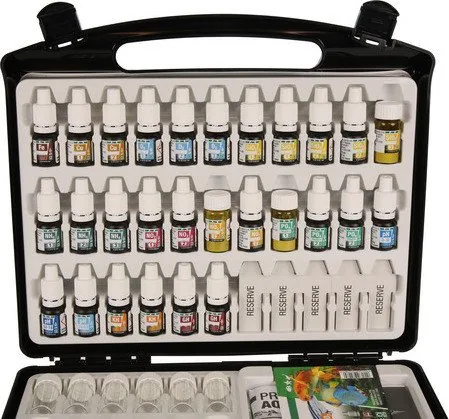
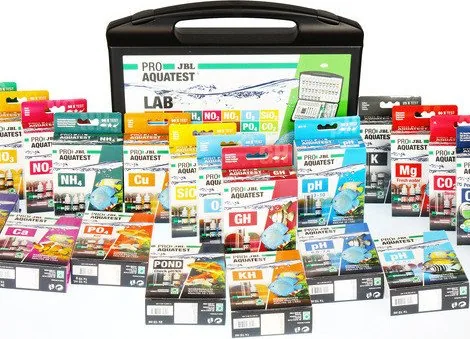
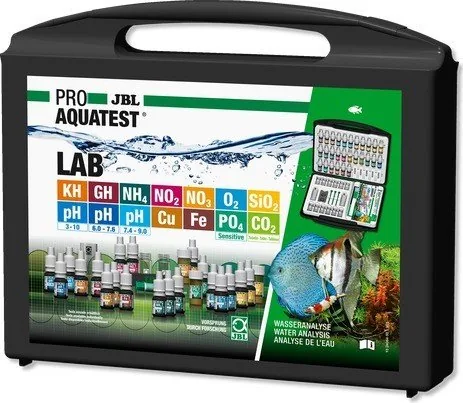
Análisis del agua (pH (3 rangos), Dureza carbonatada, Dureza total, Fosfatos, Nitritos, Nitratos, Hierro, Cobre, Silicatos, Oxígeno, Amonio, Amoníaco, CO2 Indirecto), Kit de prueba

Dimensiones

38,20x8,51x31,80cm (AnxAlxP)

Peso

1,27 kg

M: QW-35-FL

Producto Descripción

Dominando la Química del Agua del Acuario

Mantener un entorno acuático saludable requiere un monitoreo preciso de la química del agua para garantizar el bienestar de todos los organismos que viven dentro. El Manual del Estuche de Pruebas JBL Pro AquaTest Lab proporciona orientación esencial para aficionados que exigen excelencia en sus configuraciones acuáticas para mantener la mejor condición. Esta colección integral asegura que sus peces y plantas prosperen en condiciones óptimas al proporcionar instrucciones detalladas para varios métodos de análisis utilizados hoy en día.

Métodos de Prueba Esenciales para la Claridad

La calidad del agua determina el éxito de cualquier configuración de acuario independientemente de las especies específicas que mantenga. Ya sea que mantenga vida marina de agua dulce o Koi de estanque de jardín, diferentes parámetros necesitan atención específica para la estabilidad. El manual detalla métodos de titulación y colorimétricos sofisticados diseñados para precisión y facilidad de uso para todos. Las pruebas de titulación como KH y GH usan recuentos precisos de gotas para determinar niveles de dureza efectivamente con el tiempo. Las pruebas colorimétricas como pH y nutrientes esenciales dependen de tablas de color para resultados claros y legibles para verificaciones rápidas. Cada prueba incluye procedimientos paso a paso para minimizar el error del usuario durante el proceso de prueba de muestras de agua. El sistema compensa efectivamente la decoloración del agua causada por el filtrado de turba o tratamiento asegurando la fiabilidad incluso en condiciones difíciles.

Parámetros Vitales Cubiertos para la Salud

Comprender su perfil de agua es crucial para prevenir fluctuaciones peligrosas que dañen criaturas sensibles. Las pruebas de dureza como Pro AQUATEST GH y KH previenen bruscos cambios de pH que dañan criaturas sensibles significativamente. Los niveles de pH entre rangos específicos se adaptan a diferentes especies desde agua dulce ácida hasta tanques marinos alcalinos perfectamente. La prueba de nutrientes monitorea ciclos complejos de nitrógeno como Amonio, Nitrito y Nitrato para rastrear la función del sistema con precisión. Los niveles de Fosfato y Silicato ayudan a prevenir florecimientos de algas obstinados que pueden asfixiar su tanque y matar peces. Elementos traza como Hierro y Cobre son vitales para el crecimiento pero deben controlarse estrictamente para evitar riesgos de toxicidad. Los niveles de oxígeno garantizan soporte de vida para peces y bacterias mientras que la fertilización con CO2 ayuda al crecimiento exuberante de plantas en tanques plantados.

Mantenimiento y Correcciones para la Estabilidad

Mantener parámetros estables evita estrés y brotes de enfermedades en su ecosistema a largo plazo. Si los valores se desvían de los rangos recomendados, la guía ofrece pasos de corrección específicos para ajuste para solucionar problemas. Demasiado baja dureza requiere agregar sales minerales mientras el exceso sugiere usar filtración de ósmosis inversa para reducirla. Las deficiencias de nutrientes necesitan fertilizantes específicos de la gama ProScape disponible para compra en línea fácilmente. Los niveles altos de tóxicos requieren cambios de agua inmediatos o introducción de filtros biológicos para restaurar el equilibrio rápidamente. Las instrucciones de almacenamiento aseguran que los reactivos permanezcan efectivos para periodos de prueba futuros antes de que expiren. Los cuentagotas deben sostenerse verticalmente para evitar burbujas de aire durante el dispensado de reactivos. El monitoreo regular evita sorpresas inesperadas en su rutina de mantenimiento para sus tanques. Siguiendo la guía del Manual del Estuche de Pruebas JBL Pro AquaTest Lab, los propietarios de acuarios pueden lograr claridad y estabilidade del agua para sus mascotas.

M: QW-35-FL

© Copyright 2026 Manual.ly