
HiKOKI UV3628DA Manual
Manual en PDF · 248 Páginas
Español



Verificación rápida
Respuesta incorrecta, inténtalo de nuevo.
Chatee con su manual de HiKOKI UV3628DA usando IA
Obtenga respuestas instantáneas de IA de su manual de HiKOKI UV3628DA
Pregunte lo que quiera sobre HiKOKI UV3628DA. Las respuestas provienen de este manual, con las páginas en las que se basan.
UV3628DA Programa de mantenimiento
Inspeccione regularmente todos los tornillos de montaje para asegurarse de que estén correctamente apretados. Vuelva a apretarlos inmediatamente si alguno está suelto para evitar peligros.
De vez en cuando, compruebe antes, durante y después del funcionamiento que no se hayan acumulado virutas ni polvo en los terminales de la herramienta y de la batería.
Limpie el cuerpo de la herramienta con un paño humedecido en solución jabonosa para eliminar el concreto. Retire inmediatamente cualquier concreto adherido al ensamblaje flexible.
Haz una Pregunta
¿Recomiendas UV3628DA?
Sí NoPreguntas frecuentes
Se utiliza para compactar concreto fresco en cimentaciones y productos de concreto. La vibración ayuda a eliminar el aire atrapado y favorece una mezcla de concreto más homogénea.
¿Esta respuesta fue útil?
Tiene un modo Normal a 12.000 vibraciones por minuto para compactación general y áreas con encofrados sensibles. El modo Potencia alcanza 15.200 vibraciones por minuto para concreto de alta viscosidad.
¿Esta respuesta fue útil?
El UV3628DA está diseñado para baterías HiKOKI Multi Volt, incluidas BSL36A18 y BSL36B18. Las baterías existentes BSL3660, BSL3620, BSL3626 y BSL18xx no son compatibles.
¿Esta respuesta fue útil?
Inserte la varilla verticalmente, evite el contacto con el refuerzo de acero y el encofrado, y muévala entre puntos superpuestos. Retírela lentamente después de la compactación para evitar que se formen huecos.
¿Esta respuesta fue útil?
Suelte el gatillo y compruebe si hay sobrecarga o sobrecalentamiento. Elimine la causa de la sobrecarga o deje que la herramienta y la batería se enfríen completamente antes de reiniciarla.
¿Esta respuesta fue útil?
Apague la herramienta, retire la batería y limpie el concreto con un paño humedecido en una solución de jabón suave. No lave el cuerpo de la herramienta con agua ni use disolventes que puedan dañar las piezas de plástico.
¿Esta respuesta fue útil?
Ventajas y Desventajas
Ventajas

- El diseño inalámbrico de 36 V mejora la movilidad alrededor de cimentaciones, encofrados y trabajos con productos de concreto.
- Dos modos proporcionan 12.000 o 15.200 vibraciones por minuto para concreto normal y de alta viscosidad.
- Una varilla vibradora de 28 mm y un área de compactación efectiva de 280 mm permiten una consolidación sistemática del concreto.
- La protección contra sobrecarga y temperatura, las luces de advertencia y los indicadores de batería favorecen un funcionamiento más seguro.
Desventajas

- Compatible solo con baterías HiKOKI Multi Volt designadas; no se pueden utilizar series de baterías antiguas.
- El peso de 4,2 kg de la herramienta puede resultar fatigante durante trabajos prolongados o por encima de la cabeza.
- La varilla vibradora se calienta después de usarla y requiere una manipulación cuidadosa.
- El concreto, el polvo y el agua deben mantenerse fuera del cuerpo de la herramienta y de los terminales de la batería.
Producto Especificación
Vibraciones
15.200/min
Peso
4,20 kg
Producto Descripción
Vibrador de concreto inalámbrico HiKOKI UV3628 - Leer, descargar e imprimir gratis
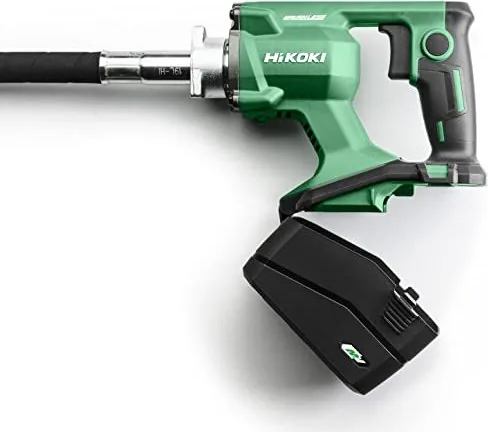
El vibrador de concreto inalámbrico HiKOKI UV3628 está diseñado para una compactación eficiente del concreto durante trabajos de cimentación, vertidos de losas y la producción de componentes de concreto. Su plataforma inalámbrica de 36 V permite a los usuarios moverse libremente por el área de trabajo sin gestionar un cable de alimentación, lo que lo hace práctico para tareas de construcción exigentes y lugares con acceso limitado a la electricidad.
Diseñado para una compactación controlada del concreto
Este modelo utiliza una varilla vibradora de 28 mm con una longitud de 187 mm y una longitud de conjunto de 825 mm. La manguera flexible permite una colocación controlada en el concreto fresco, ayudando a eliminar el aire atrapado y a favorecer una mezcla más uniforme. El área de compactación efectiva tiene aproximadamente 280 mm de diámetro, lo que permite a los operadores cubrir un vertido de forma metódica superponiendo los puntos de inserción.
Dos modos de funcionamiento proporcionan flexibilidad para diferentes condiciones del concreto. El modo Normal funciona a 12.000 vibraciones por minuto para la compactación habitual y zonas donde el encofrado puede ser más vulnerable a la deformación. El modo Potencia alcanza 15.200 vibraciones por minuto y está destinado a concreto de mayor viscosidad que necesita una consolidación más intensa.
Rendimiento inalámbrico y funciones de protección útiles
El UV3628DA utiliza baterías HiKOKI Multi Volt, incluidas la BSL36A18 y la BSL36B18. La herramienta gestiona automáticamente la potencia de las baterías compatibles de 36 V, mientras que un indicador de batería ayuda a los usuarios a controlar la carga restante. Con 4,2 kg y una batería BSL36B18, combina un conjunto vibrador robusto con un funcionamiento inalámbrico portátil.
Las funciones integradas de protección contra sobrecarga y temperatura ayudan a proteger el motor y la batería durante trabajos intensivos. Las luces de advertencia del panel del interruptor indican sobrecarga o temperatura excesiva, lo que permite al usuario detenerse, eliminar la causa del esfuerzo o dejar que la herramienta se enfríe antes de continuar. Estas funciones favorecen un uso más fiable al compactar mezclas densas o trabajar de forma continua.
Funcionamiento y cuidado prácticos
Para obtener mejores resultados, inserte la varilla vibradora verticalmente, manténgala alejada de las barras de refuerzo y del encofrado, y retírela lentamente para evitar dejar huecos. La vibración excesiva puede separar los ingredientes del concreto, por lo que es importante una colocación controlada y uniformemente espaciada. Al trabajar en pendientes, comience en el extremo inferior para aprovechar eficazmente el peso de los vertidos posteriores de concreto.
Después de usarla, elimine rápidamente los residuos de concreto con un paño bien escurrido y una solución de jabón suave. Mantenga limpias las zonas de ventilación, los interruptores, los terminales de la batería y el conjunto flexible. Evite que entre agua en el cuerpo de la herramienta, no doble ni se pare sobre la manguera flexible, y deje que la varilla vibradora se enfríe antes de tocarla.
Notas
- Utilice únicamente baterías originales HiKOKI Multi Volt designadas.
- Use protección para los ojos, la cara y los oídos durante el trabajo con concreto.
- Apague la herramienta y espere a que la vibración se detenga antes de apoyarla.
Buscar: 67.732 Manuales en línea


Escribe la marca o modelo