
Manual.ly Logo

Carson Tyrann Single Blade 320 Manual

0,0 · 0 Valoraciones

Manual en PDF · 32 Páginas

Español

M: QW-35-FL
página

/ 32

Loading...
72334901dea92b602cd5abd09530e28c6e51 page d
13 // GB
Make sure that you have sufficient insurance cover when practising your hobby or take
out a special insurance for model aircraft. The contact address for this is Deutscher
Modellfliegerverband e.V. Rochusstr. 104 – 106, 53123 Bonn.
Only a well-maintained model will function properly. Only use approved spare parts and never
improvise with any unsuitable items.
It is the user’s responsibility to ensure that the model is functioning correctly and that all nuts,
bolts and screws are tightened.
Keep the model well beyond the reach of small children. They may unintentionally activate the
model and cause themselves injury with it, or they may put batteries and small parts into their
mouths and swallow them.
Preparations
Never start flying before you have made sure of the following points:
• Pay attention to visible damage on the model, remote control, battery charger, and lithium
battery.
• Ensure that the model is functioning correctly and that all screwed and plugged connections
are fitted precisely and tightly.
• The flight battery must be fully charged and correspond to the correct voltage. Only use
new/fresh batteries for the transmitter.
• Make sure that all servos respond correctly to the signals of the transmitter.
• Always check the radio operation before starting the model.
Flight operation
The model is primarily designed for indoor flights since its low weight and unstable flight
position resulting from the construction type make it very susceptible to air movements.
Moreover, the components are not dust- and moisture-proof.
Do not fly any longer than one battery charge
Afterwards, the model must cool down for at least 5 minutes.
Then recharge the battery. Avoid deep discharge in any case.
General information
• If you have little or no experience with model aircraft you should practice with a flight
simulation program first.
• Ask experienced model pilots for advice with the fine settings of your model aircraft.
• Familiarise yourself with the control functions of your trnasmitter.
• Start your first flights, standing behind the model and looking in the flight direction. In this
case, the control reaction equals the controlling direction.
• Also familiarise yourself with the movements of the model, when it flies towards you
(response opposite to the control direction)!
Safety Precautions Lithium batteries:
1. General: Lithium batteries (accumulators) are energy storage devices with a high energy
density and can present risks. For this reason, particular care is needed when charging,
discharging, storing and handling. Read these instructions very carefully before first using the
battery. Do not fail to take note of the warning notices and instructions for use. Misuse can lead
to risks such as explosion, overheating or fire. Failure to observe the instructions for use leads to
early failure and other defects. The instructions should therefore be kept in a safe place and it is
essential that they are handed over to the second user if the batteries are passed on.
2. Warning notices:
• Avoid short-circuits. A short-circuit may well destroy the product. Cables and connections
must be well insulated.
• It is essential when connecting the battery to ensure that the polarity is correct.
• Original plug connectors and cables may not be cut off or changed - if need be, use an
adapter cable.
• Do not expose the battery to excessive heat or cold or to direct sunlight. Do not throw in the
fire. Do not place the battery in contact with water or other liquids.
• Charge the battery only with charging units intended for the purpose and always use the
balancer connection. It is only by using the balancer connection that optimum charging can
be ensured. If this connection is not used, charging is subject to the risks mentioned above.
Before charging, always first allow the battery to cool to ambient temperature. Never charge
while hot.
• When charging, place the battery on a non-flammable, heat-resistant support. There should
be no flammable or readily ignited objects in the vicinity of the battery.
• During charging or operation, never leave the battery unsupervised.
• Do not fail to keep to the recommended charge/discharge current.
• The battery casing must not be damaged. It is essential to avoid damage by sharp objects
such as knives or the like, from dropping, impact, bending etc. Damaged batteries may no
longer be used.
• Batteries are not toys. They should be kept away from children.
3. Charging instructions: Lithium batteries are charged according to the CC-CV procedure.
CC stands for “constant current“, which is applied during the first phase of charging. Once the
battery reaches the maximum voltage configured in the charger, it switches to CV (constant
voltage) for the second phase of charging. The battery voltage no longer increases. The charging
current now falls continuously until the battery is fully charged. The maximum charging current
for the battery is 1C (C=nominal capacity of the battery, e.g. for a battery with a nominal
capacity of 2700 mA, the maximum charging current for the battery is 2700 mA (2.7 A)). Never
charge several batteries together from a single charger. Differing states of charge and capacities
can lead to overcharging and destruction.
4. Storage instructions: Lithium batteries should be stored charged to 20-50 % of their
capacity and at a temperature of 15-18 °C. If the cell voltage falls below 3 V, they should be
recharged. Deep discharge and storage when discharged (call voltage <3 V) will render the
battery unusable.
5. General terms of guarantee: There is a legal guarantee for production and material faults
as applicable at the time of dispatch. No liability is accepted for normal wear and tear. This
guarantee does not apply for defects attributable to improper use, inadequate maintenance,
third-party interference or mechanical damage. This applies, in particular, to used batteries
and batteries clearly showing signs of use. Damage and loss of performance due to improper
handling and/or overload are not product faults. Batteries are consumables and subject to a
certain ageing. This is influenced by factors such as the charge/discharge currents, the charging
procedure, the operating and storage temperatures and the state of charge during storage.
The ageing shows itself in, among other things, an irreversible loss of capacity. In the model
field, where batteries are frequently used to supply motors, very high currents can flow from
time to time.
6. Exclusion of liability: Since we are unable to have any control over charge/discharge, handling,
compliance with assembly and operating instructions, battery replacement and its care and
maintenance, Tamiya / Carson can accept no liability for loss, damage or costs incurred. Any claim
for damages that may result from operation, failure or faulty operation or that is in any way related
thereto will therefore be refused. We accept no liability for personal injury or material damage and
their consequences that arise from our delivery.
7. Disposal instructions: Batteries are hazardous waste. Damaged or unusable cells must be
disposed of in the correct manner.
No liability for printing errors, we reserve the right to make changes!
SAFETY PRECAUTIONS LITHIUM BATTERIES

Chatee con su manual de Carson Tyrann Single Blade 320 usando IA

Obtenga respuestas instantáneas de IA de su manual de Carson Tyrann Single Blade 320

Pregunte lo que quiera sobre Carson Tyrann Single Blade 320. Las respuestas provienen de este manual, con las páginas en las que se basan.

Tyrann Single Blade 320 Programa de mantenimiento

Antes de cada vuelo
Inspeccionar el modelo por daños visibles

Revisa el modelo, el control remoto, el cargador y la batería en busca de cualquier daño visible antes de cada vuelo.

Mostrar en el manual (página 13)
Antes de cada vuelo
Apretar todos los tornillos y conexiones

Asegúrate de que todas las conexiones atornilladas y enchufadas estén ajustadas con precisión y firmeza antes de volar.

Mostrar en el manual (página 13)
Antes de cada vuelo
Verificar la respuesta del servo

Asegúrate de que todos los servos respondan correctamente a las señales del transmisor antes de iniciar el modelo.

Mostrar en el manual (página 13)
Antes de cada vuelo
Comprobar el alcance de radio

Comprueba siempre el funcionamiento y el alcance de la radio antes de iniciar el modelo.

Mostrar en el manual (página 13)
Después de cada vuelo
Dejar enfriar el modelo durante 5 minutos

No vueles más tiempo del permitido por una carga de batería. Deja que el modelo se enfríe durante al menos 5 minutos después.

Mostrar en el manual (página 13)
Según sea necesario
Reemplazar palas de hélice dañadas

Las palas de hélice o rotor dañadas deben reemplazarse inmediatamente. No intentes repararlas.

Mostrar en el manual (página 12)
M: qwen/qwen3.8-flash

Haz una Pregunta

0/1000

¿Recomiendas Tyrann Single Blade 320?

Sí No

Preguntas frecuentes

A

Hay una garantía de 24 meses contra defectos de fabricación válida desde la fecha de compra de un distribuidor autorizado.

¿Esta respuesta fue útil?

A

Está diseñado principalmente para uso interior. El vuelo al aire libre requiere condiciones sin viento para evitar la pérdida de control debido al peso ligero.

¿Esta respuesta fue útil?

A

La batería LiPo típicamente tarda de una a dos horas en cargar completamente usando el cargador USB incluido.

¿Esta respuesta fue útil?

A

Los niños menores de dieciséis años solo deben operar esto bajo supervisión adulta ya que no se clasifica como un juguete.

¿Esta respuesta fue útil?

A

Permita que el motor se enfríe durante al menos cinco minutos antes de intentar volar el modelo nuevamente.

¿Esta respuesta fue útil?

A

Sí, puede cambiar entre el Modo 1 y el Modo 2 usando la configuración del transmisor antes de despegar.

¿Esta respuesta fue útil?

A

El seguro a menudo es requerido por ley para aeronaves controladas por radio debido a los riesgos operativos involucrados.

¿Esta respuesta fue útil?

M: QW-35-FL

Ventajas y Desventajas

Ventajas

  • Listo para volar de la caja sin ensamblaje
  • Giroscopio integrado para comportamiento de vuelo estable
  • La iluminación LED mejora la visibilidad durante el vuelo
  • Incluye función de despegue y aterrizaje automáticos
  • El control remoto de 2.4 GHz previene interferencias
VS

Desventajas

  • Diseñado principalmente para uso interior debido a la sensibilidad al viento
  • Corta duración de vuelo por carga de batería única
  • Requiere supervisión adulta para operadores menores de 16
  • El motor requiere tiempo de enfriamiento entre sesiones de uso
  • La cobertura de seguro suele ser obligatoria para la operación
M: QW-35-FL

Producto Especificación

Tipo

Helicóptero

Frecuencia

2,4 GHz

Propulsión

Motor eléctrico

Tiempo de vuelo

18 min

Dimensiones

32,00x24,99x8,00 cm (LxAnxAl)

Peso

53,01 g

M: QW-35-FL

Producto Descripción

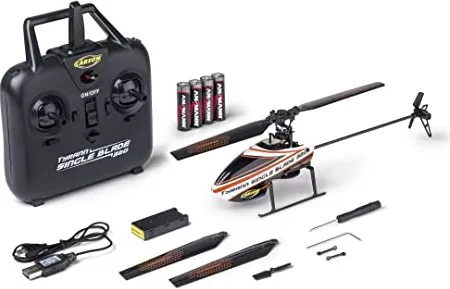
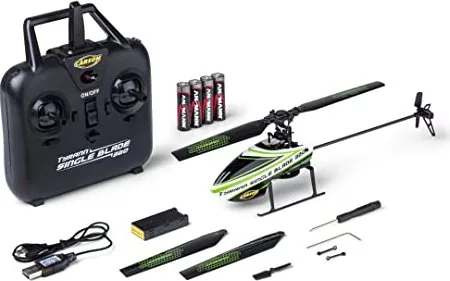
Experimenta la Alegría del Vuelo con el Carson Tyrann Single Blade 320

Recoger un nuevo modelo controlado por radio siempre es un momento emocionante para los entusiastas que buscan explorar los cielos. El Carson Tyrann Single Blade 320 destaca como una apuesta sólida en el mundo de la robótica aérea. Esta unidad está diseñada para operación inmediata, llegando lista para volar directamente de la caja sin requerir complicado trabajo de destornillador. Los usuarios aprecian la conveniencia del ensamblaje completo que minimiza el tiempo de configuración significativamente. Puede encontrar todos los detalles técnicos necesarios e instrucciones precisas refiriéndose al Carson Tyrann Single Blade 320 Manual encontrado en el paquete para asegurar la operación correcta cada vez. El sistema de control remoto de 2.4 GHz asegura una conexión estable durante sus vuelos sin interferencia. Incluye características como control de altura automático y un giroscopio integrado para estabilización. Esto hace que la curva de aprendizaje sea mucho más suave en comparación con modelos brushless más antiguos. La iluminación LED permite una mejor visibilidad, especialmente cuando vuela durante el crepúsculo o en entornos interiores con poca luz. Además, el transmisor ofrece configuraciones de Modo 1 y Modo 2, permitiendo a los pilotos elegir su configuración de acelerador preferida para operación de diestros o zurdos.

La seguridad es primordial al operar cualquier dispositivo de vuelo. El diseño es más adecuado para entornos interiores porque la construcción ligera lo hace altamente sensible a las condiciones de viento al aire libre. Se recomienda a los usuarios operar el dispositivo en habitaciones amplias libres de obstáculos como muebles. Al volar, siempre asegúrese de estar en una superficie plana y monitoree los niveles de batería de cerca para evitar choques. La batería LiPo incluida requiere protocolos de carga específicos para mantener la longevidad y prevenir peligros de seguridad durante los ciclos de carga. Asegúrese de que todos los tornillos y conexiones estén apretadas antes de intentar el vuelo para mantener la estabilidad. El voltaje de la batería debe corresponder a las especificaciones correctas para el rango de transmisión óptimo. Si el modelo no responde a los comandos, verifique primero el voltaje de la batería. El sobrecalentamiento del motor indica la necesidad de un periodo de enfriamiento antes del uso adicional. No vuele en fuerza de viento mayor a uno para mantener el control.

Notas Importantes de Mantenimiento

Las verificaciones regulares de las hélices del rotor y la respuesta del servo son esenciales para la operación segura cada temporada. Siempre reemplace las hélices dañadas inmediatamente para prevenir la inestabilidad durante los modos de hover. La garantía cubre defectos de fabricación por dos años si se compra de un distribuidor autorizado. Tenga en cuenta que el seguro es requerido para la operación según las pautas legales locales respecto a las aeronaves controladas por radio. Evite la descarga profunda de las celdas de batería para extender la vida útil general. Mantenga el modelo fuera del alcance de niños pequeños menores de dieciséis años de edad. Siempre siga las pautas encontradas en la documentación para no invalidar reclamaciones de garantía. La carga toma aproximadamente una a dos horas usando el cargador USB. Recargue solo cuando el modelo esté completamente enfriado para prevenir daños a las celdas de litio.

M: QW-35-FL

© Copyright 2026 Manual.ly